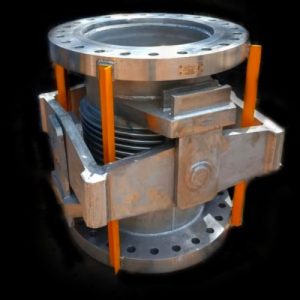
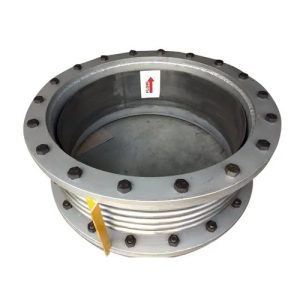
Gimbal bellows, also known as universal expansion joints, are specialized expansion joints designed to accommodate angular deflections in piping systems. Unlike axial or lateral bellows which primarily handle movement along a single axis, gimbal bellows allow for rotation in multiple planes. This makes them crucial in situations where pipes might experience significant angular changes due to thermal expansion, seismic activity, or other forces.
Here’s a detailed breakdown of gimbal bellows:
Function and Design:
* Primary Function: Gimbal bellows are designed to absorb angular movements in piping systems. They do not typically handle significant axial or lateral displacements. Their key strength is managing rotation.
* Structure: A gimbal bellows assembly consists of two or more bellows joined together by a gimbal ring. This ring is a pivoting structure that allows the bellows to rotate in multiple planes. The bellows themselves are usually of the convoluted type, providing the flexibility needed for the angular movement.
* Gimbal Ring: The gimbal ring is the heart of the design. It’s a rigid frame that connects the bellows and allows them to pivot. This ring is supported by hinges or other mechanisms that facilitate the multi-plane rotation.
* Tie Rods/Hinges: These components, along with the gimbal ring, control the movement of the bellows and ensure that the expansion joint behaves as intended. They restrict unwanted movements while allowing the desired angular flexibility.
Types of Gimbal Bellows:
* Single Gimbal: Allows angular movement in one plane.
* Double Gimbal: Allows angular movement in two planes. This is the most common type and offers greater flexibility.
* Universal Gimbal: Can accommodate angular movement in three planes.
Applications:
Gimbal bellows are used in various industries where angular pipe movement is a concern:
* Power Generation: Used in steam lines and other high-temperature piping systems where thermal expansion causes significant angular changes.
* Chemical Processing: Employed in piping systems that handle corrosive or hazardous fluids, where flexibility is needed to prevent stress on the pipes.
* Refineries: Used in crude oil and other processing units where temperature and pressure variations can cause angular movement.
* Cryogenic Applications: Used in systems handling extremely cold fluids, where thermal contraction can lead to angular displacement.
* HVAC Systems: In large HVAC systems, especially in areas prone to seismic activity, gimbal bellows can protect the piping from damage.
Advantages of Gimbal Bellows:
* Multi-Plane Rotation: Their primary advantage is the ability to handle angular movement in multiple directions.
* Reduced Stress on Piping: By absorbing angular deflections, they minimize stress on the piping system and connected equipment.
* Compact Design (Relative to Function): While more complex than simple bellows, they offer a relatively compact solution for managing complex angular movements.
Considerations when Selecting Gimbal Bellows:
* Angular Movement: The primary factor is the amount of angular deflection the bellows needs to accommodate.
* Pressure and Temperature: The operating pressure and temperature of the system are crucial for material selection and design.
* Pipe Size and Diameter: The size of the piping system dictates the size of the bellows.
* Material Compatibility: The bellows material must be compatible with the fluid being conveyed and the surrounding environment.
* Installation Space: Ensure there is enough space to accommodate the gimbal bellows and its associated hardware.
* Maintenance: Regular inspection and maintenance are essential to ensure the long-term reliability of the gimbal bellows.