
NON - Metalic Expansion Joints
Perfect Bellow Solution

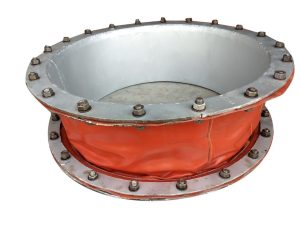
Non-metallic expansion joints come in various types, each designed for specific applications and movement requirements. Here are the primary types of non-metallic expansion joints:
1. Elastomeric Expansion Joints*
– Material: Made from elastomers like Neoprene, EPDM, or silicone.
– Features: Highly flexible and capable of absorbing various types of movements (axial, lateral, angular).
– Applications*: Often used in HVAC systems, water and wastewater facilities, and chemical processing due to their excellent resistance to abrasion and environmental factors.
2. Fabric-Reinforced Expansion Joints
– Material: Comprise multiple layers of fabrics (nylon, polyester) impregnated with elastomers for added strength.
– Features: These joints provide flexibility and can handle moderate pressure and temperature fluctuations.
– Applications: Common in blower and duct systems, as well as in applications involving vibration absorption.
3. Rubber Expansion Joints
– Material: Typically made from rubber compounds with specific formulations for different applications, including oil resistance, heat resistance, and chemical resistance.
– Features: Designed to handle angular displacement, longitudinal movement, and lateral movement.
– Applications: Widely used in piping systems, pumps, compressors, and similar equipment where flexibility is required.
4. Plastic Expansion Joints
– Material: Constructed from materials like PVC, CPVC, polypropylene, or PTFE (polytetrafluoroethylene).
– Features: Lightweight, resistant to corrosion and chemicals, but with limited temperature and pressure capabilities compared to metal joints.
– Applications: Ideal for chemical processing, pharmaceutical applications, and other systems involving aggressive chemicals.
5. Composite Expansion Joints
– Material: Made from advanced composite materials, offering high strength-to-weight ratios and corrosion resistance.
– Features: Designed for high-performance applications, capable of withstanding extreme temperatures and corrosive environments.
– Applications: Frequently used in power generation, oil and gas, and specialized chemical processing systems.
6. PTFE (Teflon) Expansion Joints
– Material: Made primarily of polytetrafluoroethylene (PTFE).
– Features: Exceptional chemical resistance and low friction properties; suitable for extreme temperatures.
– Applications: Commonly used in corrosive environments, such as in the chemical industry, food processing, and semiconductor manufacturing.
7.Bellows Joints
– Material: Often made from rubber or polymeric materials designed in a bellows shape.
– Features: Can accommodate axial, lateral, and angular movement, and effectively handle vibrations.
– Applications: Used in various sectors including HVAC, fluid transfer, and industrial piping systems.
8.Duct Expansion Joints
– Material: Constructed with fabric or elastomeric materials, designed to connect ductwork.
– Features: Allow for thermal expansion and contraction in air handling systems, while also reducing noise and vibration.
– Applications: Primarily used in ventilation and exhaust systems, including industrial fans and HVAC installations.